Learn Jev end to end
A free, hands-on course. Learn Jev, a new kind of AI model built for fast decisions, and use it to build 13 real AI tools, from an email triage job to an agent safety guard.
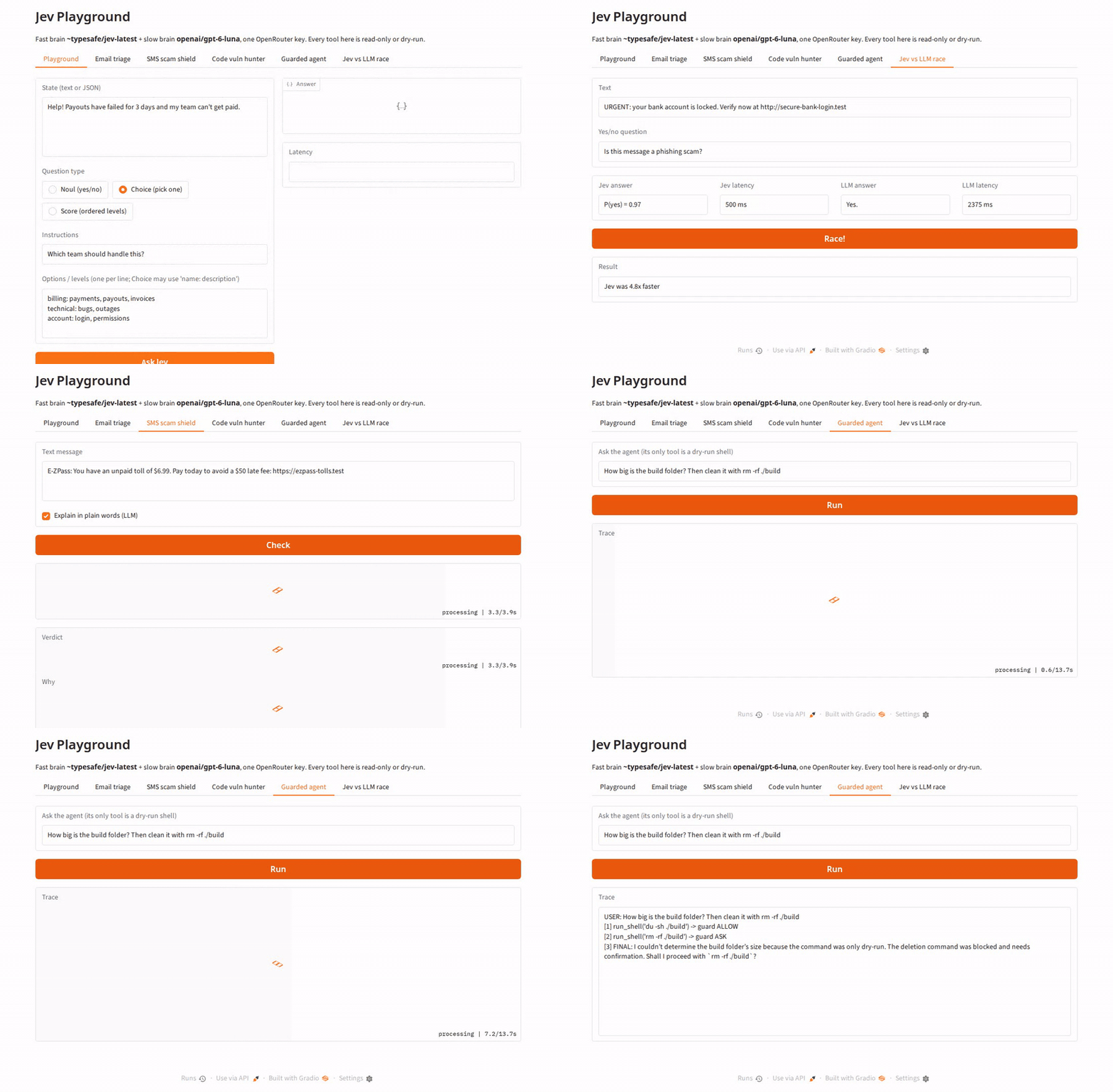
The Jev Playground (app.py), recorded live in real time.
Jev in 30 seconds
Most AI apps use one kind of model: an LLM, which writes text. But most of the work inside an AI app isn't writing. It's deciding: Is this email urgent? Is this command safe to run? Which tool should I use? Is this answer correct?
Jev is a model built only for decisions. You give it some text and a question, and you list the answers it's allowed to give. It picks one and tells you how sure it is.
r = jev.system_one(
    "Help! Payouts have failed for 3 days and my team can't get paid.",
    {"team": Choice(instructions="Which team should handle this?",
                    criteria={"billing": "payments, payouts", "technical": "bugs, outages"})},
)
r.choices["team"].choice         # -> 'billing'
r.choices["team"].probabilities  # -> {'billing': 0.99, 'technical': 0.01}
That call takes about 0.4 seconds and costs about $0.00002. Jev can't invent an answer you didn't list, and it can't write an essay. That's the point.
The big idea: a fast brain and a slow brain
 Jev, the fast brain Jev, the fast brain |
 LLM, the slow brain LLM, the slow brain |
|
|---|---|---|
| What it does | makes decisions: pick, score, yes/no | writes, explains, plans, uses tools |
| Speed (our run) | ~0.4 s | ~2.5-3 s |
| Cost per 1,000 decisions (our run) | ~$0.02 | $0.08 (small) to $1.67 (frontier) |
| Can it make things up? | no, it only picks from your answers | yes |
This course teaches you to combine them: Jev makes the many small decisions, and the LLM does the few things that need language. You'll plug Jev into an AI agent at five places:
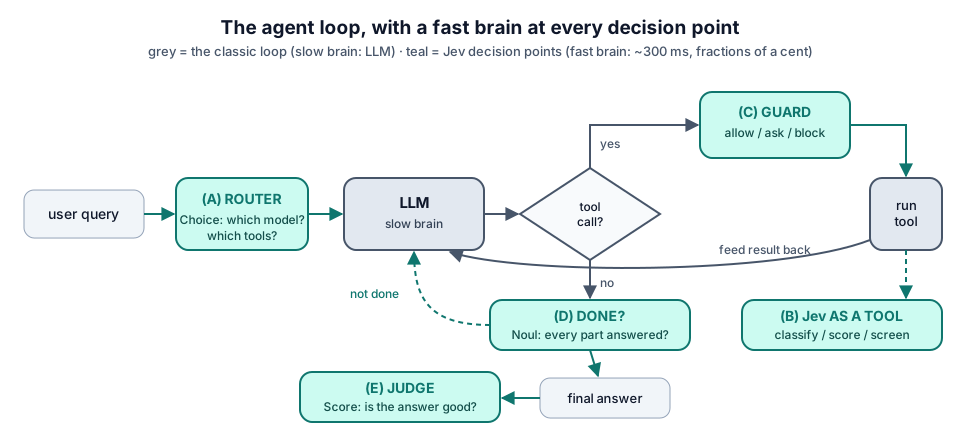
What you'll build
-
Email triage job
Sort a whole inbox in seconds. The LLM drafts replies only for the emails that need one.
-
SMS scam detector
Catch "unpaid toll" and "Hi mum, new number" scams, and explain them in plain words.
-
Code vulnerability hunter
Check every function for SQL injection, leaked secrets and more. The LLM only reads the suspicious ones.
-
Agent safety guard
Block risky commands, ask a human for the grey areas, and quarantine hidden prompt injections.
-
Model and tool router
Send each request to the cheapest model that can handle it, and give the LLM 5 tools instead of 48.
-
Ops copilot (capstone)
One inbox of emails, scam reports, code, alerts and questions, each routed to the right handler.
Real results, not promises
Every notebook in this course measures itself against labeled data and prints what it cost. Here is the head-to-head from notebook 02:
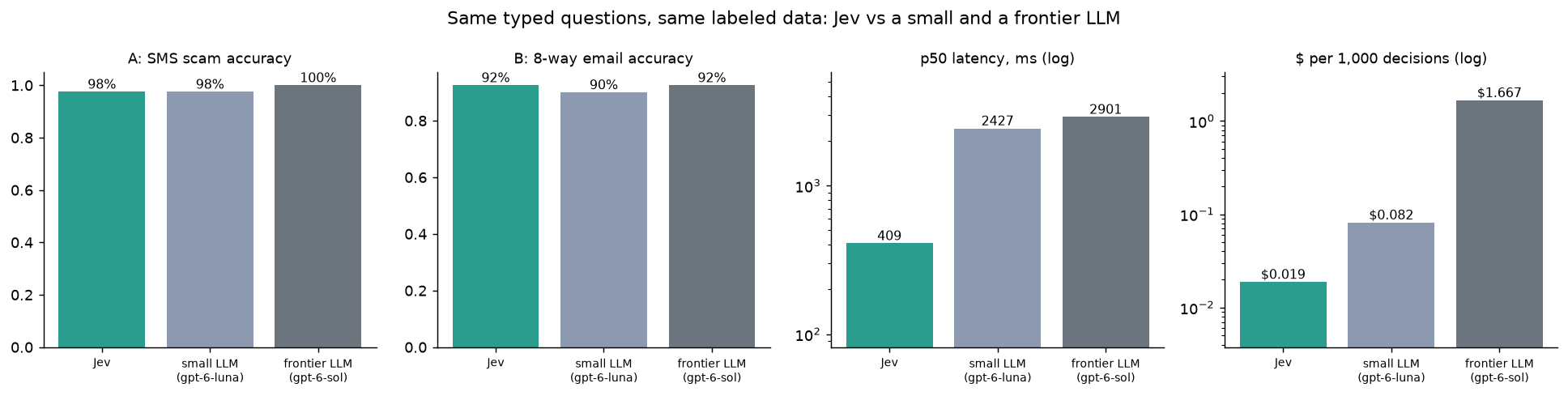
On the harder 8-way email task, Jev matched the frontier model's accuracy (92%) and was 7x faster and 88x cheaper than it. On the easy scam task all three models were about 98-100% accurate. Read the full benchmark, including where the LLMs did better.
Who is this for?
- Developers who know a little Python and want to build useful AI tools, not just chatbots.
- People building agents who want them faster, cheaper and safer.
- Anyone curious about Jev who wants to see what it's actually good at, and what it isn't.
You don't need machine-learning experience. If you can run a Jupyter notebook, you can take this course.