Benchmarks
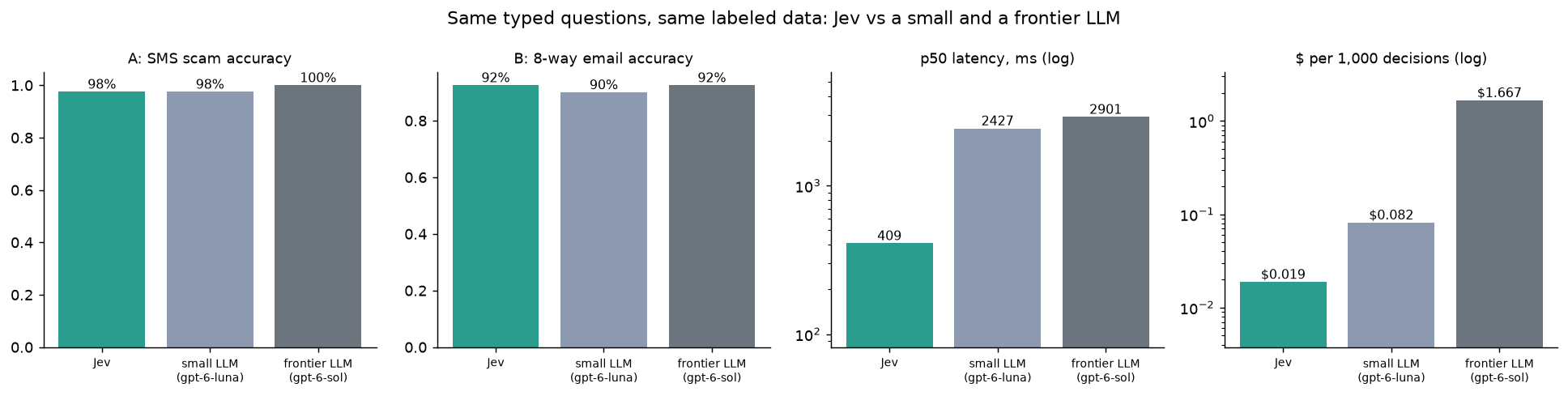
Notebook 02 asks the same typed questions about the same labeled data to three contestants, and reports everything, including where Jev lost.
Setup
| Contestant | How it answers |
|---|---|
Jev (typesafe/jev-1.13-20260917) |
the System One API, through OpenRouter |
Small LLM (openai/gpt-6-luna) |
the same typed question, through system-one-adapter |
Frontier LLM (openai/gpt-6-sol) |
the same, with a big model |
The adapter makes the LLMs answer the exact same Noul / Choice questions and return probabilities, so
this is a like-for-like comparison, not a prompt-writing contest. Every contestant ran with 4 parallel
workers.
| Task | Data | Question |
|---|---|---|
| A: SMS scam (easy) | 40 texts, 20 scams | Noul: is this a scam? |
| B: email category (harder) | 40 emails, 8 categories | Choice: which of 8 categories? |
Results (run of 2026-09-23)
| Contestant | A: accuracy | A: Brier ↓ | B: accuracy | p50 latency | p95 latency | $ per 1,000 decisions |
|---|---|---|---|---|---|---|
| Jev | 98% | 0.029 | 92% | 409 ms | 686 ms | $0.019 |
| Small LLM | 98% | 0.008 | 90% | 2,427 ms | 3,848 ms | $0.082 |
| Frontier LLM | 100% | 0.000 | 92% | 2,901 ms | 4,271 ms | $1.667 |
Jev vs the small LLM: 5.9x faster, 4.3x cheaper. Jev vs the frontier LLM: 7.1x faster, 88x cheaper.
Numbers move a little between runs: an earlier run the same day gave 6.8x / 8.1x faster and 87x cheaper. The ratios, not the exact milliseconds, are the stable result.
How to read this honestly
- The easy task saturates. Every model gets about 100% on obvious scam texts, so task A mostly tells you about speed and cost.
- The LLMs had better Brier scores on task A. They were confident and right on an easy set. Jev put some legitimate-but-scammy-looking texts (a bill that's due, a sale ending tonight) in the 0.1-0.5 range. It didn't block them, but it was less certain.
- On the harder task, Jev matched the frontier model (92%) and beat the small one (90%).
- Speed and cost are Jev's clearest advantage. It was 6-7x faster at the median and 4-88x cheaper per decision, and its latency was more consistent (p95).
- Structural advantages don't show up in a table: Jev's answer is always one of your options (no parsing, no retries), and one call answers many questions at once.
Per-class results (task B)
Precision, recall and F1 for each email category. There are only 5 emails per class, so one mistake moves a class's recall by 0.2: read this as a map of where errors happen, not as a per-class benchmark.
| Class | Jev P / R / F1 | Small LLM P / R / F1 | Frontier LLM P / R / F1 |
|---|---|---|---|
| action_request | 0.83 / 1.00 / 0.91 | 0.83 / 1.00 / 0.91 | 0.83 / 1.00 / 0.91 |
| meeting | 1.00 / 0.80 / 0.89 | 1.00 / 0.60 / 0.75 | 1.00 / 0.80 / 0.89 |
| billing | 1.00 / 1.00 / 1.00 | 1.00 / 1.00 / 1.00 | 1.00 / 1.00 / 1.00 |
| newsletter | 1.00 / 1.00 / 1.00 | 1.00 / 1.00 / 1.00 | 1.00 / 1.00 / 1.00 |
| security_alert | 1.00 / 1.00 / 1.00 | 1.00 / 1.00 / 1.00 | 1.00 / 1.00 / 1.00 |
| phishing | 1.00 / 1.00 / 1.00 | 1.00 / 1.00 / 1.00 | 1.00 / 1.00 / 1.00 |
| personal | 1.00 / 0.60 / 0.75 | 1.00 / 0.60 / 0.75 | 1.00 / 0.60 / 0.75 |
| notification | 0.71 / 1.00 / 0.83 | 0.62 / 1.00 / 0.77 | 0.71 / 1.00 / 0.83 |
| macro F1 | 0.92 | 0.90 | 0.92 |
All three models struggled with the same boundary: personal vs action_request / notification. Jev's three misses were "Can you drive on Saturday?" (a friend's request, labeled personal, read as an action request), "Water shut-off tomorrow 9-12" (labeled personal, read as a notification) and "Meeting recording available" (labeled meeting, read as a notification). These are arguably labeling ambiguities as much as model errors. Tightening the category descriptions is the fix.
Known limits, tested live
Notebook 02 also tries three of Jev's documented weak spots: counting, date comparison and adversarial text. Jev got these particular examples right, but TypeSafe's own docs say not to rely on it for them, so the course does them in code. See When not to use Jev.
Run it yourself
It takes about 2 minutes and costs about $0.14, mostly the frontier model. Change MODEL and
SMART_MODEL in .env to benchmark other LLMs. Your numbers will differ from ours: that's the point of
running it.