Fast brain, slow brain
The problem with LLM-only agents
An AI agent is a loop. It asks the LLM what to do, runs the tool the LLM picked, feeds the result back, and repeats until the LLM gives a final answer. (The prequel course, build-your-first-ai-agent, builds that loop in about 35 lines.)
Look closely and the loop is full of small decisions:
- Which model should answer this request?
- Is it safe to run this command?
- Is this web page trying to hijack the agent?
- Did the agent actually finish the task?
- Was the final answer any good?
In an LLM-only agent, the LLM makes all of them, slowly and expensively, and often not at all: nobody checks whether the command is safe, because checking would double the cost.
The fix: give the agent a fast brain
Jev takes over the small decisions. Each one costs ~0.4 seconds and a fraction of a cent, which is cheap enough to make on every step. The LLM keeps doing what only it can do: reasoning, writing and calling tools.
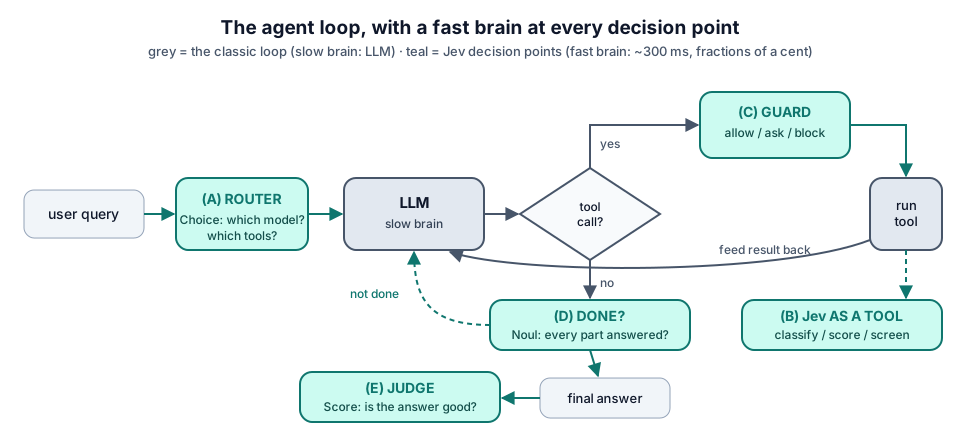
There are five places to plug Jev in. Notebook 03 adds all five to the same loop.
(A) Router: before the loop
A Choice picks the model tier (or the tools) for a request. If Jev isn't confident, play it safe and use
the stronger model.
def route(query, min_confidence=0.7):
    r = ask_jev(query, {"tier": Choice(
        instructions="Which model tier should handle this request?",
        criteria={"fast": "lookups, arithmetic, single-step tasks",
                  "capable": "multi-step planning, design, root-cause analysis, anything high-stakes"})})
    a = r.choices["tier"]
    tier = a.choice if a.confidence >= min_confidence else "capable"   # unsure -> play safe
    return SMART_MODEL if tier == "capable" else MODEL
(B) Jev as a tool: inside the capability table
Give the LLM a tool that calls Jev. The LLM decides when to classify, and Jev does the classifying.
def classify_syslog(line):
    """Classify a syslog line: severity, subsystem, and whether a human must act now."""
    r = ask_jev(line, {"severity": Score(...), "subsystem": Choice(...), "page_now": Noul(...)})
    return {...}
(C) Guard: before any tool runs
Before every tool call, check it. Read-only tools pass straight through. Risky calls get
allow / ask / block, and ask goes to a human.
def jev_guard(name, args, user_request):
    r = ask_jev({"tool": name, "args": args, "user_request": user_request}, {
        "verdict": Choice(instructions="Should an agent run this without asking a human?",
                          criteria={"allow": "...", "ask": "...", "block": "..."}),
        "irreversible": Noul(instructions="Could this cause an outage or lose data?"),
    })
    ...
(D) "Am I done?": when the LLM says it's finished
LLMs sometimes stop early. Before accepting the final answer, ask Jev whether every part of the task has been answered. If not, send the model back to work.
(E) Judge: after the answer
Score every final answer. It's cheap enough to run on all of them, as a quality monitor in production or as an eval gate in CI (notebook 11).
The whole loop, with two hooks
The course uses one agent loop everywhere. It's the classic loop plus two optional hooks for the guard and the done gate:
def run_agent(user_query, tools, registry, system="...", model=None,
              before_tool=None, check_done=None, max_iterations=8, verbose=True):
    messages = [{"role": "system", "content": system}, {"role": "user", "content": user_query}]
    for step in range(1, max_iterations + 1):
        resp = client.chat.completions.create(model=model or MODEL, messages=messages, tools=tools)
        msg = resp.choices[0].message
        if not msg.tool_calls:                                   # the LLM thinks it's finished
            feedback = check_done(user_query, msg.content) if check_done else None   # (D)
            if not feedback:
                return msg.content
            messages += [{"role": "assistant", "content": msg.content or ""},
                         {"role": "user", "content": feedback}]
            continue
        messages.append(...)                                    # record the tool calls
        for tc in msg.tool_calls:
            name, args = tc.function.name, json.loads(tc.function.arguments or "{}")
            blocked = before_tool(name, args) if before_tool else None               # (C)
            result = {"blocked": blocked} if blocked else registry[name](**args)
            messages.append({"role": "tool", "tool_call_id": tc.id, "content": json.dumps(result)})
    return "Stopped: hit max_iterations."
Beyond the loop: three more patterns
The use cases combine the decision points with three patterns you'll see again and again:
| Pattern | How it works | Where you'll see it |
|---|---|---|
| Classify, then act | Jev decides every item; the LLM works only on the slice that needs language | email triage, scam detector |
| Map-reduce | Jev checks every chunk; the LLM reads only the flagged ones | vulnerability hunter, log triage |
| Layered checks | exact rules in code + Jev for intent + a human for grey areas | guardrails, scam detector |
Next: When not to use Jev.